
Carroll County Criminal Court Cases
Carroll County criminal court cases are divided by court level. Arkansas felony matters and other circuit-level criminal filings belong in Circuit Court, and Carroll County is part of the 19th Judicial Circuit-East. The local circuit file holder is the Carroll County Circuit Clerk, Sara Huffman, at 210 W. Church Ave. in Berryville. The county lists the clerk's phone numbers as 870-423-2422 and 479-253-8646.
District court remains important because not every criminal matter starts as a circuit felony. Citation, traffic, ordinance, and lower-level misdemeanor matters may be connected to district departments in Berryville, Eureka Springs, Green Forest, or the broader Third Judicial District Court structure that also references Huntsville. A searcher should identify the court before assuming that one office has every docket entry.
Circuit Clerk Records at 210 W. Church
The Circuit Clerk is the local keeper for Carroll County Circuit Court criminal case files. The county's Circuit Clerk page describes an office that issues summons, warrants, and writs and records orders, judgments, injunctions, and other court-authorized documents. For a circuit criminal case, that makes the clerk's office the practical source for certified copies, filed judgments, and questions about whether an online result is complete.
The Carroll County Circuit Clerk page was assigned as a source for Carroll County criminal court case records. The captured page image was not available in the manifest, but the research ties that office directly to court filings, warrants, writs, and court-document handling.
Searching Carroll County Case Records
Search ARCourts is the main public online path for Carroll County criminal case records when the court's data is available through the Arkansas Judiciary system. Arkansas Judiciary describes Search ARCourts as public case information for courts using the Contexte Case Management System. The better the identifiers, the cleaner the result: case number is usually strongest, while party-name searches may need narrowing for common names.
- Open Search ARCourts and choose the participant, case-number, or case-description search context that fits what you know.
- Enter the party name carefully, using first, middle, and last name fields when available, or enter the case number if you have it.
- Use advanced filters where available to narrow by court, case type, filing period, or other displayed fields.
- Open the result and review the court, judge, parties, charges, dispositions, filings, judgments, and future events.
- Contact the filing court for missing documents, certified copies, older files, or records that are not posted online.
The Search ARCourts public case-search interface is the state source assigned to this page.
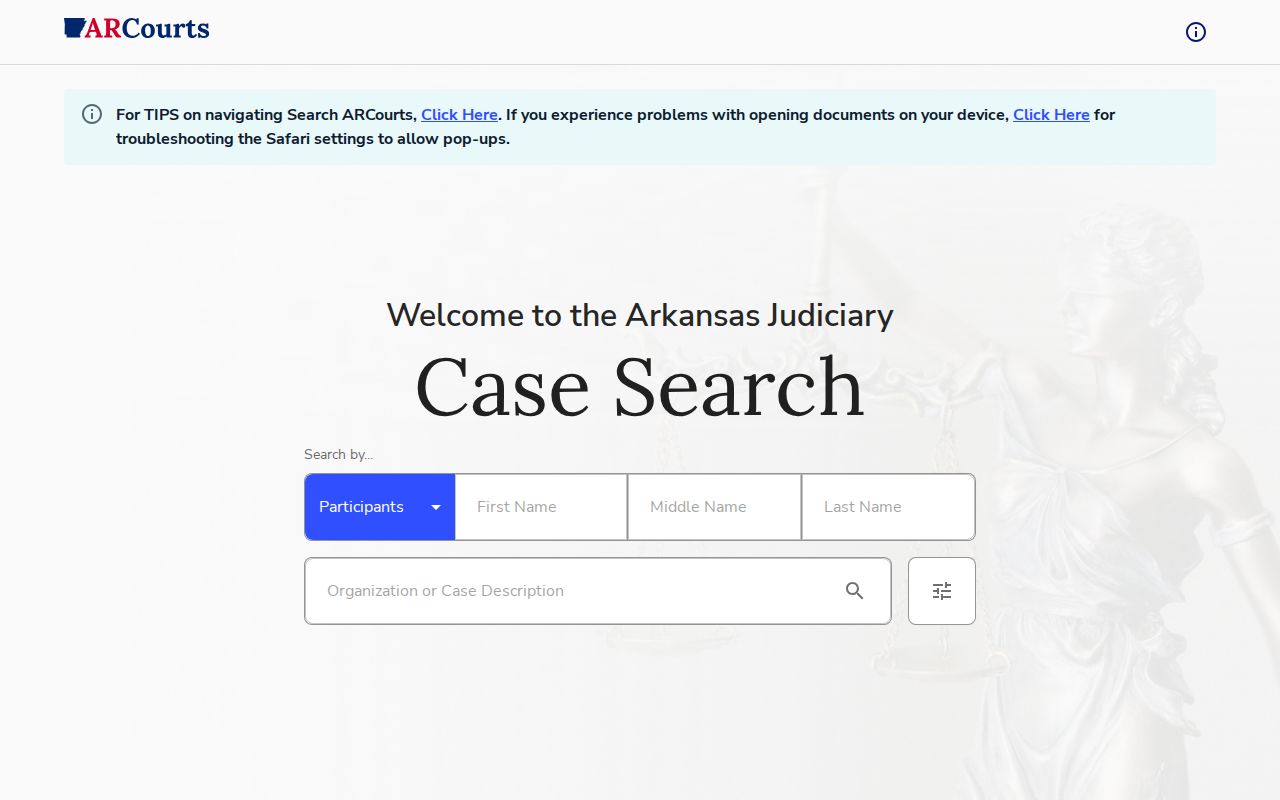
For Carroll County, that interface is a starting point for public case information, while the official court file remains with the court where the case is filed.
| Search ARCourts Field | Type | Required | How It Helps |
|---|---|---|---|
| Search by | Dropdown | Yes | Use participant search for a person, or another available context for case description or organization searches. |
| First Name | Text | No | Helpful when a last name is common or when multiple Carroll County results appear. |
| Middle Name | Text | No | Can separate similar names if the court data includes a middle name or initial. |
| Last Name | Text | Practically yes for name search | The main participant-search field for locating a person's case records. |
| Organization or Case Description | Text | No | Appears in non-participant contexts and may help with descriptive searches. |
| Advanced filters | Icon control | No | Use filters to reduce noise before relying on a result list. |
District Departments by City
Carroll County has a two-seat geography and several local court paths, so the phrase "Carroll County court" can be too broad. The research identifies Berryville, Eureka Springs, Green Forest, and Alpena entries in the district-court layer. Eureka Springs publishes a district court page for the Third Judicial District Court serving Carroll and Madison Counties, including Berryville, Eureka Springs, Green Forest, and Huntsville.
The practical distinction is filing level. A felony charge should route to Circuit Court and the Circuit Clerk. A city citation, fine-only matter, traffic case, or local misdemeanor may begin with a district department or city payment channel before a fuller court file is visible online. Berryville's citation counter, for example, is tied to city police citation payment rather than a statewide repository record.
The Arkansas Judiciary Carroll County directory was assigned as a source for local court entries.
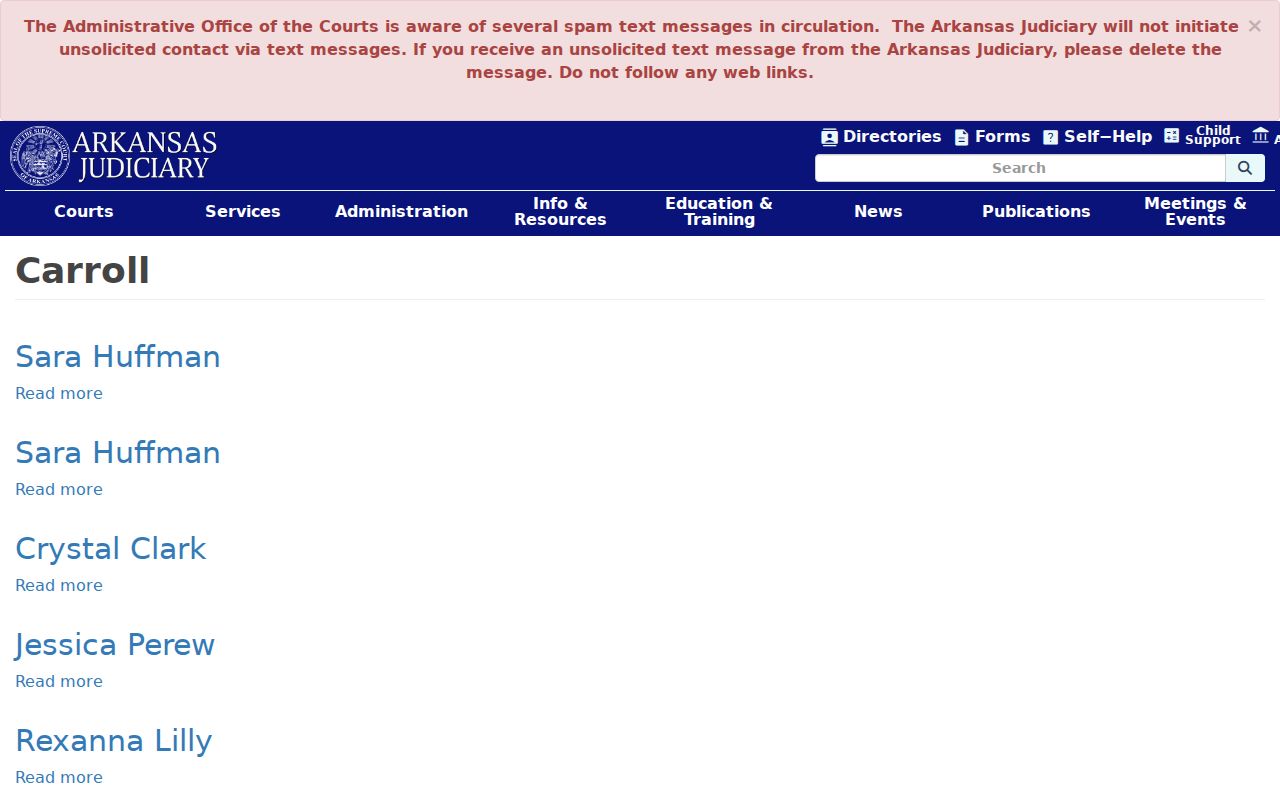
That directory context matters when a case result points to a district department instead of the Carroll County Circuit Clerk.
Inside a Carroll County Case File
A Carroll County criminal court case file is the court's record of prosecution activity. It is different from a sheriff booking record, a police incident report, or an Arkansas State Police and ACIC criminal-history product. The case file focuses on charges as filed in court, parties, judge, docket events, hearings, judgments, dispositions, sentence terms, and future court settings where those categories are public.
| Case Number & Court | Identifies the filing court, division or department, and docket number used by the clerk and Search ARCourts. |
|---|---|
| Parties & Judge | Shows the named participants and the assigned judge when that information is public. |
| Charging Document | May include complaint, information, indictment, citation, or other filing that states the court charge. |
| Docket Entries | Chronological record of filings, hearings, orders, motions, notices, and court events. |
| Charges & Dispositions | Shows filed charges and outcomes such as plea, conviction, dismissal, acquittal, or nolle prosequi when posted. |
| Future Events | May list upcoming hearings, review dates, or trial settings if public and available online. |
| Judgment & Sentence | Records the final order, sentence, probation terms, fines, or other conditions where applicable. |
Charges and Future Events
Search ARCourts may show charges, dispositions, filings, future events, and judgments, but those labels do not all mean the same thing. A charge is the allegation filed in court. A filing is a document or docket entry. A future event is a scheduled court date. A disposition is the court outcome for a charge or case. A judgment is the court's formal order.
Those distinctions help when an arrest and a court case do not match exactly. Police allegations can be amended by the prosecutor, dismissed, reduced, or filed under different wording. Section 18 of the research also notes that the prosecutor's charging decision is the point where police reports and arrests become filed court cases. The Circuit Clerk's file holds the filed case and disposition, while prosecution work product and victim communications may have separate public-record limits.
How a Criminal Case Moves
A Carroll County criminal case generally moves from a law-enforcement event into a charging decision, then into a court docket. Not every arrest becomes a filed case, and not every citation becomes a circuit matter. Once charges are filed, the court record becomes the place to track arraignment, pretrial settings, plea or trial activity, disposition, and sentencing.
For felony classifications, Arkansas circuit court is the expected court level. Class Y, A, B, C, D, and unclassified felony matters route to Circuit Court, while Class A, B, and C misdemeanors or violation-level matters may appear in district court depending on the charge and procedure.
Warrants From Court to Sheriff
Warrants connect the court record to the sheriff's public-record workflow. The sheriff's official records guidance says the Carroll County Sheriff's Office maintains thousands of arrest warrants issued by District Court and Circuit Court. It also says warrant information available by phone may include the warrant date, charge, bond amount, and issuing court.
That means a warrant may appear as a court event, a sheriff-held warrant record, or both, depending on where the search starts. If a Carroll County criminal court case shows a capias or bench warrant, the sheriff may be the agency responsible for service. If the question is whether a warrant is active or what bond is listed, the sheriff's phone channel is often the direct local route, while the court file explains the underlying case event.
Case Record Access & Restrictions
Arkansas court records are public in many circumstances, but online access is not unlimited. Administrative Order 19 governs access to and confidentiality of court records. The Arkansas Judiciary help materials warn that some information is not public under that order and will not be available on the Internet. Juvenile matters, sealed records, restricted personal data, and some sensitive case information may be missing from an online view even when an official file exists.
The sheriff's public-records guidance has parallel limits for law-enforcement records, including active investigations, certain personnel records, sealed or expunged records, juvenile offender or suspect records, and records held by other agencies. Court records also are not Arkansas State Police or ACIC rap sheets. Repository criminal histories are controlled through Arkansas State Police and ACIC channels, while Search ARCourts is a court-case search.
The Arkansas Judiciary Search ARCourts help page explains the public case-information system and online access limits.
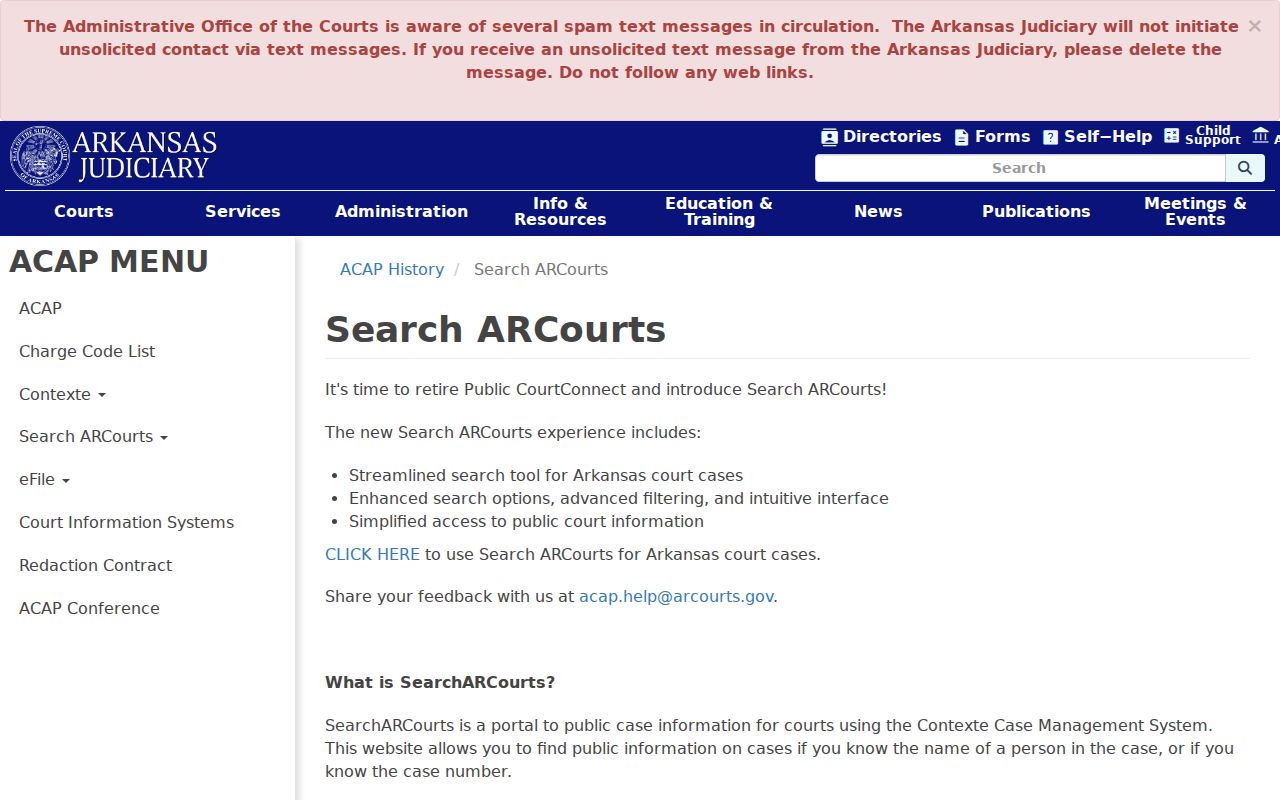
When the online court search is silent or incomplete, the next step is not to assume there is no case; it is to contact the court that would hold the official file.
Court Files Are Not Rap Sheets
A court-file search answers a narrower question than an official statewide criminal-history check. Search ARCourts can show filed cases, charges, dispositions, future events, judgments, and some public documents. It does not show every police report, every jail booking, every out-of-county event, or every repository entry in ACIC systems.
For someone reviewing their own Carroll County record, the cleanest approach is to separate the channels. Use Search ARCourts and the Circuit Clerk for the filed court case. Use the sheriff or city police agency for local incident, citation, booking, or warrant records. Use Arkansas State Police and ACIC channels for state repository products. If the question starts with an arrest and moves into prosecution, the related Carroll County arrest lookup page covers the booking side of that path.